
How Privacy Checkup Transformed User Engagement at Uber
Overview
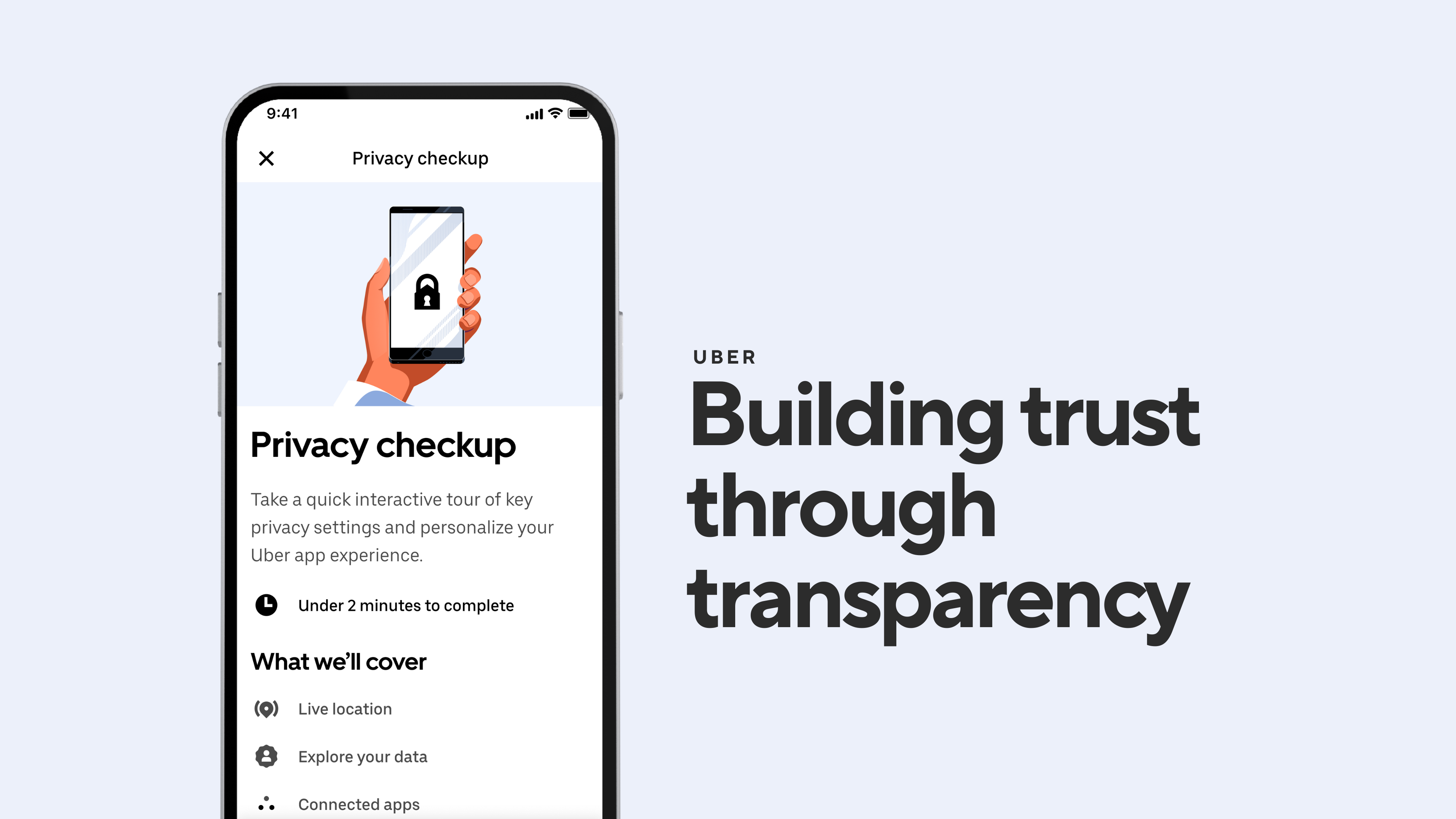
Privacy Checkup is a proactive privacy management feature designed to increase user trust and transparency on the Uber platform.
The feature guides users through reviewing and updating their most important privacy settings. The initiative was grounded in research that found users care about privacy, but lack awareness of how to manage their privacy settings.
Duration: 8 months
My Role: Product Design Lead
Cross-functional Team: 1 PM, 1 GPM, 6 Engineers, 2 Legal Specialists, 2 Product Counsel, 1 Data Analyst, 1 Content Designer
Platform: iOS & Android (Global Launch)
Key Objectives
- Raise awareness and engagement with privacy settings.
- Reinforce Uber’s reputation for trust and safety.
- Avoid increasing opt-out rates for essential settings
The Challenge
Only 2% of Uber customers ever visited privacy settings, yet 78% expressed concerns about data usage in surveys.
Before Privacy Checkup, users had to navigate through 5+ taps and legal jargon to find privacy controls. When major data breaches hit the news, our support tickets spiked 40%, but users still couldn’t easily find or understand their privacy options. We needed to proactively educate users without creating friction in core journeys like requesting rides or ordering food.
How might we build user trust while maintaining the transparency, and the seamless Uber experience users expect?

Solution: Privacy checkup
A guided, mobile-first experience that proactively surfaces privacy controls through three focused modules:
Module 1: Location Sharing
Review and adjust live-tracking preferences with clear explanations of when location is used
Module 2: Ad Personalization
Simple toggles for data-driven advertising with examples of what “personalized” means
Module 3: Third-Party App Access
Manage external integrations, like Cornershop and Rosetta Stone
Key Design Principles:
- Engaging visuals over dense walls of text
- Clear, plain language over legal jargon
- Neutral presentation of options, respecting user choice
- Contextual nudges to avoid banner fatigue
Research
Uncovering User Privacy Mental Models
We conducted 12 in-depth interviews across our pilot regions (New Zealand, Australia, Canada) and ran card sorting exercises with 200+ participants to understand privacy mental models.
Key Insights:
- “I only think about privacy when something bad happens in the news. Then, I panic and don’t know where to start.” – Uber Eats customer
- “I don’t want to spend 20 minutes figuring out what everything means.” – Uber driver
Three Critical Patterns Emerged:
- Reactive Behavior: People are more likely to engage with privacy after learning about incidents or news/media stories
- Clarity: Participants preferred clear, simple explanations over legalese and walls of text
- Data users care about most: Drivers and couriers prioritized payment security; while riders focused more on location sharing

DESIGN PROCESS & EXPLORATION
Simplifying Complex Privacy Concepts
My biggest design challenge was organizing complex privacy concepts into digestible modules. I explored multiple approaches:
- Option A: A single-page flow, showing all privacy settings in one linear experience
- Option B: Topic-based modules with dedicated pages for each privacy setting
- Option C: Stack ranking, with risk-based hierachy, surfacing the most sensitive settings first
Through rapid prototyping and stakeholder workshops, Option B emerged as the winner as users could focus on what mattered most to them.
Entry point strategy
I designed the Privacy Checkup experience to launch annually, via a dismissible banner. The disappearance logic dictated that the banner would disappear after completion of the checkup or persist up to 7 days with no engagement. This approach balanced our goal to increase awareness and visibility of Privacy settings, while also preventing banner fatigue.
Content & interaction design
Working closely with Content Design and Legal partners, I designed an experience that included:
- Plain language explanations replacing legal jargon
- Privacy icons from our design system for quick scanning and enhanced understanding
- Neutral framing that didn’t nudge users toward any specific choice
- One-tap controls for each privacy category
Results and Impact
Protecting the Business While Building User Trust
Privacy Checkup successfully maintained stable opt-out rates while dramatically increasing privacy awareness and engagement across our 200M+ user base.
Pilot performance by the numbers:
- 27% lift in privacy product visits
- 20% lift in privacy engagement
- 32% completion rate for end to end experience
- 2% click-through on entry banner
- 4.7/5 star rating with 93% CSAT (vs 78% industry benchmark)
What users actually did:
- Users showed greatest interest in “Explore Your Data” section (11.3% engagement)
- Location controls generated moderate interest (7.6%)
- Third-party apps had lower engagement but highest satisfaction when used (4.5% engagement, 4.9/5 rating)
What I Learned & What’s Next
Design Decisions That Worked:
The annual cadence and entry point logic proved crucial. Timing and context matters when asking users to engage with privacy. Users felt the yearly check-in was natural rather than intrusive. Our modular approach also resonated strongly, as users appreciated being able to focus on sections most relevant to them. Perhaps most significantly, using plain language instead of legal jargon led to a significant reduction in privacy-related support tickets post-launch.
If I Could Do It Again:
I would invest more heavily in accessibility testing, particularly for screen reader optimization, and expand pilot testing to more diverse geographic regions earlier in the process to catch regional differences sooner.
Future Opportunities:
Moving forward, we’re exploring the best location for an evergreen entry point for Privacy Checkup, and contextual prompts throughout the year to maintain privacy awareness when it matters most. We’re also planning to expand localization for better global coverage as we scale to new markets.
Building the Foundation for Trust
Privacy Checkup set a new standard for transparency at Uber, demonstrating that user education and business goals can align. The project showcased effective cross-functional collaboration and proved that clear, respectful privacy communication builds both user trust and platform value.
This work contributed to Uber’s broader privacy transformation, helping establish the company as a leader in proactive user transparency in the mobility and food delivery space.